Confessions of a Poet Laureate by Charles Simic
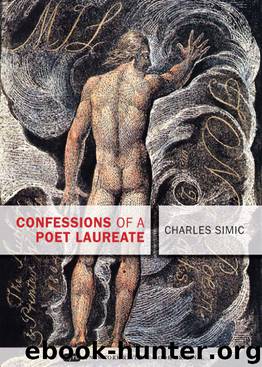
Author:Charles Simic [Simic, Charles]
Language: eng
Format: epub
ISBN: 978-1-59017-478-4
Publisher: New York Review Books
Published: 2010-12-28T05:00:00+00:00
The Buster Keaton Cure
I have a collection of Buster Keaton’s films I bought in the late 1980s when they first became available on video. It’s made up of nineteen half-hour shorts and his nine full-length films, all made between 1920 and 1928. Every few years I take a look at some of them, and recently, being thoroughly depressed by our wars and our politics, I watched a dozen of his shorts to cheer myself up. Almost ninety years old, these shorts are still very funny and visually beautiful. They make the Dada and Surrealist pranks that scandalized everybody in that era seem dated and tame in comparison.
Charlie Chaplin’s bum is at the mercy of a cruel world. Keaton, with his impassive face and a hat flat as a pancake, is a stoic. He confronts one setback after another with a serenity worthy of a Buddhist monk. In one short film, “The Goat” (1921), he’s standing on the sidewalk behind two tailor’s dummies, under the impression that they are at the end of a bread line. When he discovers his mistake, he moves on quietly.
Keaton’s movies were a big success in Europe since his type of comedy doesn’t need a translation. I first saw one of his shorts in occupied Belgrade during World War II. I liked him instantly. His films are full of remarkable acrobatic stunts. Keaton started out in vaudeville when he was four years old working with his parents, whose comedy act included a lot of roughhousing. He was thrown by his father across the stage and sometimes even at the hecklers in the audience.
The plot of a good comedy can be written on a postcard, Keaton said. For instance, in “Cops” (1922) a girl tells the hero, either you become a successful businessman, or I won’t marry you. Everything that happens in this delightful short follows from his effort to fulfill her request.
Keaton claimed that it was much harder to make a short comic film than a full-length one in which the story is uppermost, since a short film is nothing but a series of gags that follow from the original premise. For the gags to work, they have to be timed just right. Even after a film was completed, he reshot some of the gags if he felt they were executed either too quickly or too slowly—and many of them, of course, were extremely difficult to do. In “Neighbors” (1921), when a young woman cries for help from a third-floor apartment across the street, Keaton and two other men each step out of their three respective windows to form a human totem pole and rush to her rescue.
At the same time, he warned against the dangers of rehearsing a comic scene too much. To be successful, a scene had to keep its feel of improvisation. In “One Week” (1920), an uncle gives a pair of newlyweds a build-it-yourself house and a plot of land. A disappointed rival alters the numbers in the boxes containing the house, so that when Keaton begins to assemble it, the result is freakish.
Download
This site does not store any files on its server. We only index and link to content provided by other sites. Please contact the content providers to delete copyright contents if any and email us, we'll remove relevant links or contents immediately.
The Universe of Us by Lang Leav(15082)
The Sun and Her Flowers by Rupi Kaur(14529)
Adultolescence by Gabbie Hanna(8931)
Whiskey Words & a Shovel II by r.h. Sin(8024)
Love Her Wild by Atticus(7763)
Smoke & Mirrors by Michael Faudet(6198)
Wiseguy by Nicholas Pileggi(5795)
The Princess Saves Herself in This One by Amanda Lovelace(4985)
Love & Misadventure by Lang Leav(4853)
Memories by Lang Leav(4806)
Milk and Honey by Rupi Kaur(4754)
Bluets by Maggie Nelson(4565)
Too Much and Not the Mood by Durga Chew-Bose(4353)
Pillow Thoughts by Courtney Peppernell(4288)
Good morning to Goodnight by Eleni Kaur(4239)
The Poetry of Pablo Neruda by Pablo Neruda(4113)
Algedonic by r.h. Sin(4066)
HER II by Pierre Alex Jeanty(3614)
Stuff I've Been Feeling Lately by Alicia Cook(3460)
